Working notes on what we're seeing in dossiers, hearings, and renewals — written for toxicologists and regulatory leads, not for the algorithm. Plain language, footnoted where it matters, and never re-spun from a press release.
A RAAF refusal is rarely about the chemistry alone. Walking through what changes between an original justification that is refused and a revised version that is accepted — the empirical anchor, the toxicokinetic argument, the AOP-anchored mode of action, and the uncertainty analysis the original usually leaves implicit. Read against OECD GD 418 (3rd ed.), EFSA's 2025 read-across guidance, and the RAAF.
Read the article →
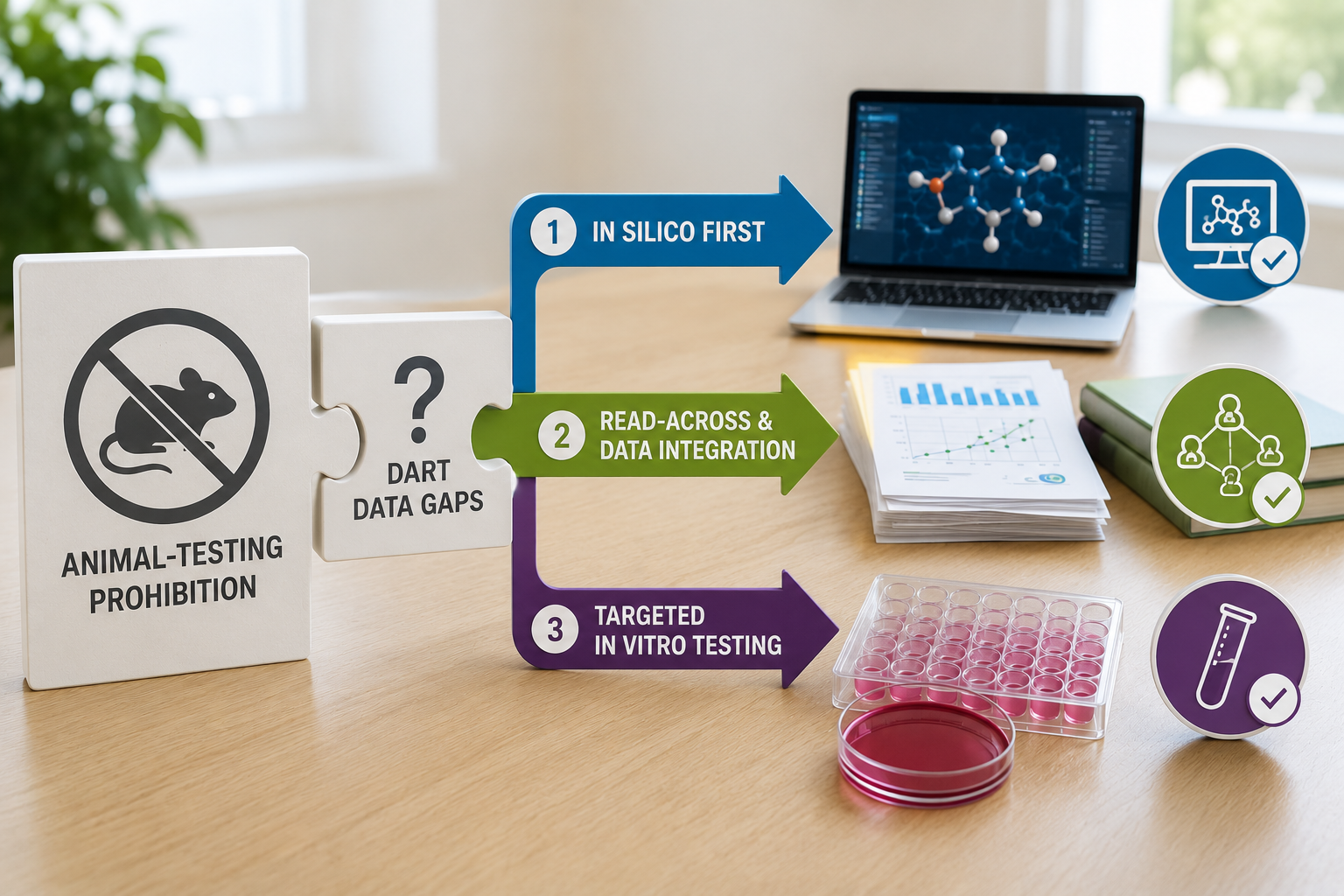
Article 18, read-across from analogues with pre-2013 data, NAM-derived evidence anchored to defined developmental endpoints, and PBPK-informed IVIVE. When each is defensible to SCCS, and when it is not.
Activity versus adversity, EATS-mediated versus EATS-sensitive, and the non-endocrine MoA argument that has to be evaluated, not asserted. With the CLP 2023/707 ED hazard classes layered on top.
Compound-specific AIs replacing defaults, the NMPEA recalculation and what it implies for downstream surrogates, and the three control-strategy paths that have crystallised since the 2023 deadlines.
A RAAF refusal is rarely about the chemistry alone. What changes between an original justification that is refused and a revised version that is accepted — the empirical anchor, the toxicokinetic argument, the AOP-anchored mode of action, and the uncertainty analysis the original usually leaves implicit.
No round-ups. No re-spun press releases. One article you might not otherwise find time to read, plus a paragraph on what we are watching in regulatory science this month.