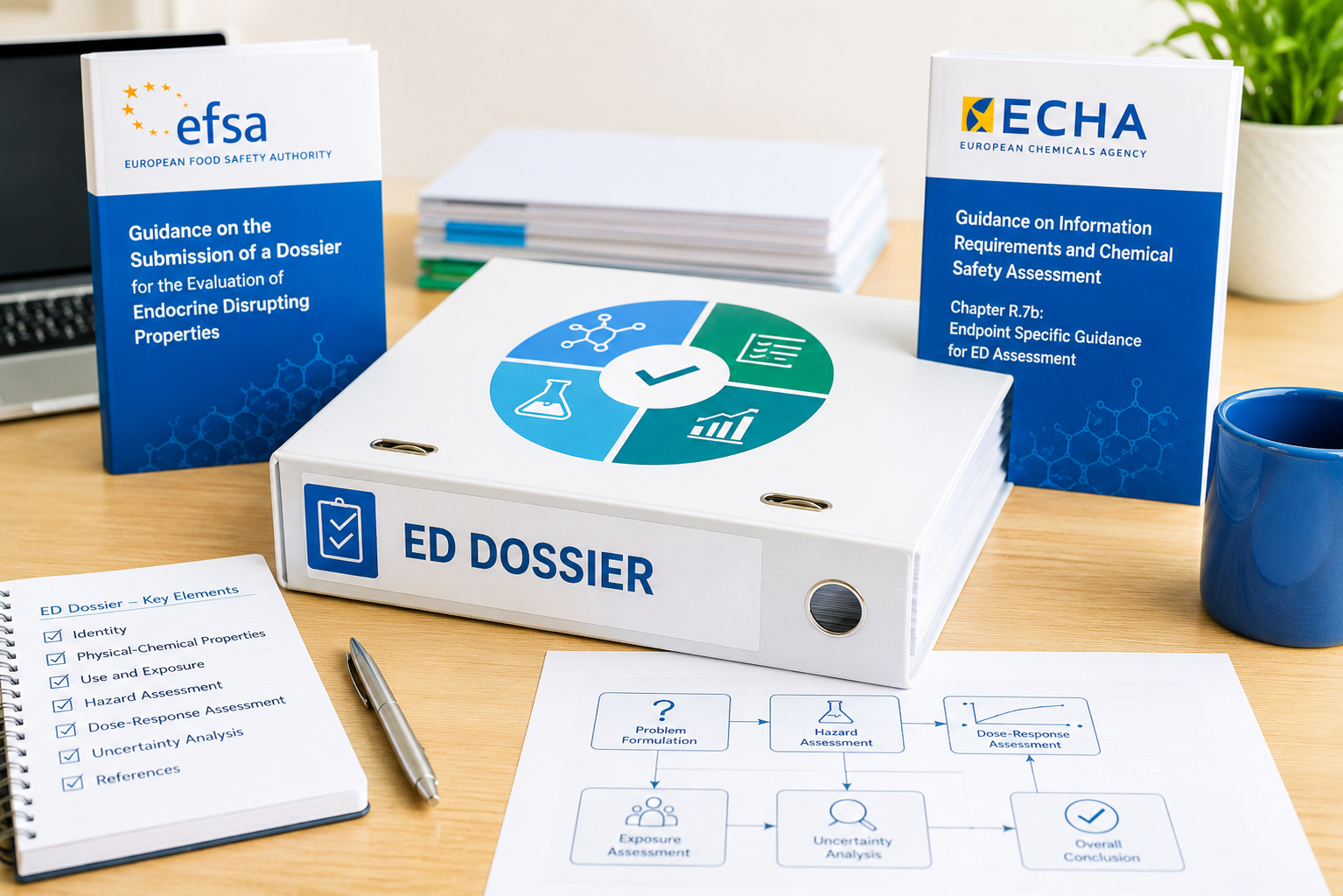
Activity versus adversity, EATS-mediated versus EATS-sensitive, and the non-endocrine MoA argument that has to be evaluated, not asserted. With the CLP 2023/707 ED hazard classes layered on top.
Endocrine disruptor assessments under the Biocidal Products Regulation and the Plant Protection Products Regulation are evaluated against the EFSA / ECHA Guidance for the identification of endocrine disruptors (EFSA Journal 2018;16(6):5311). The Guidance is now seven years old, and the operational structure of the document is well-tested across active substance dossiers.
Two further developments shape how it is applied in 2026: the EU CLP hazard classes for endocrine disruptors (ED HH and ED ENV, Categories 1 and 2) introduced through Commission Delegated Regulation (EU) 2023/707, and the broader implementation experience that has accumulated since the Guidance came into force.
Reading the Guidance carefully and constructing a dossier around its internal logic is a different exercise from assembling toxicological evidence and asking the Guidance to accommodate it. Three patterns recur in dossiers that are vulnerable under evaluation.
The Guidance is explicit that endocrine activity and endocrine-mediated adversity are distinct concepts. The ED criteria, set out in Commission Delegated Regulation (EU) 2017/2100 for biocides and Commission Regulation (EU) 2018/605 for plant protection products, require that the substance shows an adverse effect, has endocrine activity, and that there is a biologically plausible link between the two.
In practice, dossiers frequently present in vitro receptor activation, steroidogenesis assay outputs, or WoE summaries that combine activity and adversity into a single narrative. The Guidance expects these to be evaluated separately. A receptor binding signal is endocrine activity. A pubertal development effect is adversity. Each EATS modality (estrogenic, androgenic, thyroid, steroidogenesis) has to be assessed in its own right, and the link between activity and adversity documented as a biologically plausible mode-of-action argument.
The Guidance distinguishes between EATS-mediated parameters (those whose response is driven by the endocrine modality in question) and EATS-sensitive parameters (those that may respond to endocrine perturbation but also to other modes of action). The hierarchy matters: an EATS-mediated apical effect is more weighted than an EATS-sensitive one in establishing the biologically plausible link.
Dossiers that present every potentially endocrine-related observation as carrying equivalent evidentiary weight rely on the evaluation to do the categorisation. This is rarely successful. The parameters will be reclassified during evaluation, and the strength of the dossier's conclusion may be downgraded in the process. Submissions that explicitly classify each apical observation as EATS-mediated or EATS-sensitive, with reasoning grounded in the OECD Conceptual Framework levels and the Guidance's parameter tables, retain control of the evidentiary narrative.
The same applies to the postulated mode of action. The Guidance asks whether the postulated MoA is biologically plausible, empirically supported, specific to the endocrine modality, dose-response concordant, and consistent across studies. Each of these is assessed independently. A MoA narrative that addresses only biological plausibility, however well-argued, leaves four assessment elements for the evaluation to fill in.
The Guidance allows applicants to argue that an apical adverse effect, while observed, is not endocrine-mediated. This is sometimes the strongest available defence against an ED conclusion. It also requires the most rigorous evidentiary support.
Asserting that a non-endocrine mode of action exists is not sufficient. The non-endocrine MoA has to be characterised, supported by mechanistic evidence, and shown to be sufficient to explain the apical effect under the dose conditions tested. The evaluation will compare the strength of the endocrine-mediated MoA hypothesis against the strength of the non-endocrine alternative. The substance is identified as an endocrine disruptor only if the endocrine-mediated MoA is biologically plausible and the non-endocrine alternatives have been adequately considered and excluded.
Dossiers that present a non-endocrine MoA as a brief paragraph at the end of the ED assessment are routinely treated as not having seriously argued the alternative. The result is that the endocrine conclusion stands by default. A non-endocrine MoA argument that has any prospect of success has to be developed with the same scientific care as the primary EATS evaluation.
Commission Delegated Regulation (EU) 2023/707 introduced ED HH and ED ENV hazard classes into the CLP Regulation, with effective dates of 1 May 2025 for substances and 1 May 2026 for mixtures. The classification criteria for ED HH and ED ENV Category 1 are aligned with the BPR / PPP ED criteria. A Category 2 classification has been added, where evidence of endocrine activity and adversity is present but not sufficient for Category 1.
The practical effect is that substances assessed under BPR or PPP for ED criteria now also generate evidence relevant to CLP self-classification. A substance not identified as an ED under BPR may still meet ED HH Category 2 criteria under CLP, if the evidence is suggestive but not sufficient for Category 1. Conversely, substances under REACH that have not been formally assessed against ED criteria may need to be re-examined now that CLP self-classification obligations apply.
Building an ED assessment under CLP is therefore not a separate exercise. The same line-of-evidence structure, the same EATS modality evaluation, and the same MoA reasoning apply. The CLP classification rules add a Category 2 option that does not exist under BPR or PPP, and they require classification independent of regulatory authorisation status.
Three operational points follow.

Regulatory toxicologist with extensive endocrine-disruptor dossier experience across BPR, PPP and REACH. Conference presentations on EATS-modality evaluation, MoA reasoning, and cosmetic ingredient ED assessment.